

Workplace Meals
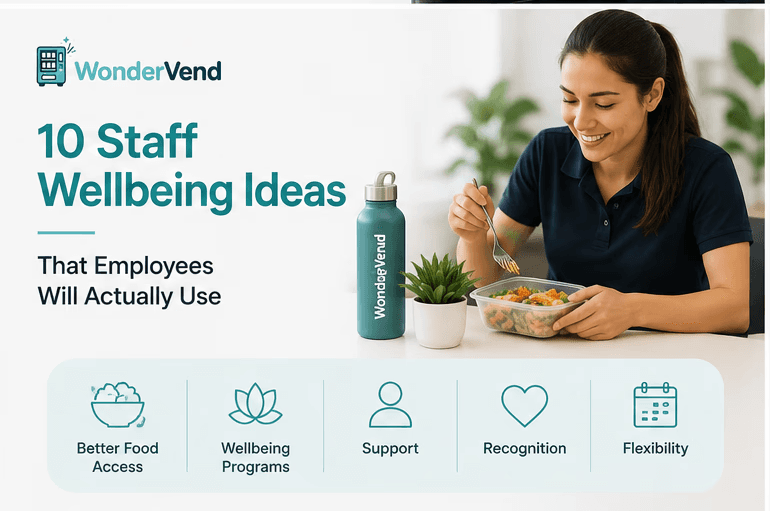
10 Staff Wellbeing Ideas That Employees Will Actually Use
Looking for practical staff wellbeing ideas? Here are 10 workplace initiatives that can improve the everyday employee experience — including options for shift workers and 24/7 workplaces.
WonderVend
10 Staff Wellbeing Ideas That Employees Will Actually Use
Employee wellbeing has become a much bigger focus for Australian workplaces.
But there's an important difference between having a wellbeing initiative and having one employees genuinely value.
A program might look impressive on paper, but if employees rarely interact with it, struggle to access it or don't see how it improves their working day, its impact can be limited.
Some of the most effective staff wellbeing ideas are much simpler.
They improve the everyday experience of being at work.
That might mean making it easier to access a proper meal during night shift, giving employees somewhere comfortable to take a genuine break, recognising good work or providing greater flexibility where the job allows it.
Here are 10 practical ideas worth considering.
1. Improve access to food during the working day
Food is an obvious part of the employee experience, but workplace access can vary enormously.
An employee working in a CBD office may have dozens of lunch options within walking distance.
Someone working an evening shift at an industrial facility may have almost none.
This is particularly relevant for:
factories
warehouses
logistics facilities
manufacturing sites
construction and infrastructure workplaces
depots
businesses operating early starts or night shifts
Employers don't necessarily need to build a staff cafeteria to improve the situation.
Depending on the workplace, options can include catered meals, food trucks, traditional vending or refrigerated self-service meal stations.
The objective is simply to ask:
Can our employees conveniently access a suitable meal when they're actually at work?
For workplaces operating outside conventional hours, improving that access can be a very tangible wellbeing initiative.
2. Subsidise meals or healthy food options
Providing food is one option.
Helping employees pay for it is another.
An employer could contribute towards meals, provide a fixed allowance, subsidise selected healthier options or provide meals completely free of charge.
The advantage of a food subsidy is its visibility.
Rather than being an employee benefit that might be used once or twice a year, food can be something employees experience every week — or even every shift.
It can also be structured to suit the business rather than requiring an all-or-nothing approach.
For example, an employer could contribute a set amount towards each meal while employees pay the balance.
For shift-based workplaces, this can also help ensure the benefit is accessible beyond conventional office hours.
3. Create better break spaces
A wellbeing program doesn't always require another app, platform or subscription.
Sometimes the physical workplace itself is the better place to start.
Look at the areas where employees spend their breaks.
Are they comfortable?
Is there enough seating?
Can employees actually switch off from their work environment?
Are there refrigerators, microwaves and basic kitchen facilities?
Is the space clean and inviting?
A relatively modest improvement to a lunchroom or break area can potentially affect employees every single working day.
4. Make wellbeing accessible to every shift
This is an area businesses operating 24/7 should pay particular attention to.
It's easy for workplace initiatives to unintentionally favour employees working conventional hours.
A catered lunch at noon is great for day shift.
What does night shift receive?
A wellbeing event at 10 am may work for office employees but not someone finishing an overnight roster.
When assessing any staff wellbeing idea, ask:
Can all of our workforce actually access this benefit?
If not, consider how it could be adapted.
The same principle applies to food, recognition programs, communications, training and workplace events.
5. Give employees genuine recognition
Employee recognition doesn't need to mean an elaborate rewards platform.
Managers recognising good work consistently can be extremely valuable.
The key is making recognition meaningful rather than mechanical.
That could include celebrating:
safety milestones
exceptional customer feedback
project achievements
years of service
team performance
employees helping colleagues
continuous improvement ideas
Recognition can also be adapted to different workplace environments.
For some businesses, a formal company-wide award works well. For others, smaller and more frequent acknowledgement from supervisors may feel much more genuine.
6. Offer flexibility where the role allows it
Not every workplace can offer remote work.
A warehouse picker can't work from home. Neither can someone operating machinery on a production line.
But flexibility isn't limited to location.
Depending on operational requirements, businesses might explore flexibility around start and finish times, roster preferences, shift swaps, compressed working arrangements or leave.
The appropriate options will vary significantly between industries.
The point is not that every employee needs complete flexibility.
It's that businesses should consider where flexibility genuinely can exist, rather than treating it as an office-only concept.
7. Support physical activity
Physical wellbeing initiatives can range from substantial corporate fitness programs to extremely simple ideas.
Businesses might provide discounted gym memberships, organise team activities, encourage walking groups or support participation in community sporting events.
At larger sites, employers can also consider whether the workplace environment itself encourages movement.
The right initiative depends heavily on the workforce.
An office employee sitting at a desk for eight hours has very different physical wellbeing considerations from someone performing manual work throughout their shift.
8. Improve the basics employees use every day
Before introducing another major wellbeing initiative, look at the everyday workplace experience.
Are drinking-water facilities easily accessible?
Are bathrooms and change rooms well maintained?
Are lockers adequate?
Is the lunchroom comfortable?
Is parking causing unnecessary frustration?
Are employees provided with appropriate facilities for their working conditions?
Individually, these things might seem minor.
Collectively, they shape how employees experience their workplace every day.
Fixing persistent workplace frustrations can sometimes deliver more value than introducing a completely new program.
9. Ask employees what they actually want
One of the easiest ways to waste money on employee wellbeing is to guess.
A short employee survey can identify what people actually value.
Rather than asking broadly whether employees want "better wellbeing", give them practical choices.
Would they value subsidised meals?
Better break facilities?
Gym membership?
More social events?
Roster flexibility?
Additional recognition?
Professional development?
The results may vary considerably between different locations, age groups, job functions and shifts.
That information allows employers to invest in benefits employees are more likely to use.
10. Think about wellbeing as part of the employee experience
Employee wellbeing shouldn't necessarily sit in isolation.
It overlaps with employee engagement, workplace culture, benefits, recruitment and retention.
A useful question for HR and operational leaders is:
What is it actually like to work here every day?
That shifts the conversation from individual wellbeing initiatives towards the overall employee experience.
The answer may involve major programs.
But it may also involve a series of smaller improvements that make employees feel their workplace has been designed with them in mind.
What makes a good staff wellbeing initiative?
There isn't a universal answer.
A corporate office, manufacturing facility and logistics warehouse have completely different workforces and operating environments.
The best initiatives tend to share a few characteristics.
They're relevant to the employees receiving them.
They're accessible, including to employees working outside normal office hours.
They're easy to use without unnecessary administration.
And they're visible enough that employees actually recognise the benefit being provided.
That's why understanding the workforce should come before choosing the program.
Workplace meals as an employee wellbeing initiative
For workplaces with limited food access, a meal program can be one practical component of a broader employee wellbeing strategy.
This can be particularly relevant for businesses operating early mornings, evenings, overnight or across rotating shifts.
A refrigerated self-service meal station allows meals to remain available when cafés, lunch bars and other food options may be closed.
Employers can also decide how they want the program structured — from employees purchasing their own meals through to partially or fully subsidised programs.
At WonderVend, our Workplace Meal Program is designed around the individual workplace, including employee numbers, shift patterns, available facilities and existing food access.
The objective isn't simply to install a vending machine.
It's to determine whether better access to meals could genuinely improve the employee experience at that site.
Want to explore what this could look like at your workplace?
Talk to WonderVend about a solution built around your workforce and site requirements.